
Air Source Heat Pump Installation
Future-proof your heating with ultra-efficient air source heat pumps. Renewable heating technology that extracts warmth from outdoor air, delivering exceptional efficiency while dramatically reducing your carbon footprint and energy bills.
Serving properties across England including London, Birmingham, Manchester, Leeds, Liverpool, Bristol, Sheffield, Newcastle, Nottingham, and Southampton.
Why Choose Universal Gas for Air Source Heat Pumps?
MCS certified installation with full grant application support and performance guarantees
Comprehensive Service
Combine heat pumps with solar PV for maximum efficiency. Use free solar electricity to power your heating, achieving near-zero running costs during sunny periods.
Grant Application Support
We manage your entire Boiler Upgrade Scheme application, securing up to £7,500 government funding. Our experience ensures quick approval and payment directly to reduce your installation costs.
Technical Expertise
Detailed heat loss surveys and system sizing ensure optimal performance. We specify correctly sized heat pumps that deliver promised efficiency without oversizing or undersizing.
Solar Integration
Large-scale heat pump systems for offices, warehouses, agricultural buildings, and light industrial properties. Designed for three-phase supplies and high heating demands.
Air Source Heat Pump Systems
Professional solutions sized for every property type
5-8kW Residential
Perfect for well-insulated homes, flats, and smaller properties with modest heating requirements.
10-12kW Residential
Most popular capacity for typical family homes with standard insulation levels.
14-16kW Large Homes
Higher capacity for larger properties, older buildings, or those with higher heat loss.
20kW+ Commercial
High-output systems for commercial properties, agricultural buildings, and multi-unit developments.
Our Professional Installation Process
Comprehensive service from survey through to performance monitoring
Heat Loss Survey
Detailed room-by-room heat loss calculations measuring insulation, windows, ventilation, and building fabric to specify the correctly sized heat pump.
Grant Application
We complete your Boiler Upgrade Scheme application, managing the process and liaising with Ofgem to secure your £7,500 government funding.
System Installation
MCS certified engineers install outdoor unit, hot water cylinder, controls, and upgrade radiators if required. Typical installation takes 2-3 days.
Commissioning & Training
Full system commissioning including weather compensation setup, control training, and performance monitoring to ensure optimal efficiency.
Air Source Heat Pump Applications
Modern Residential Properties
New builds and well-insulated homes built post-2000 are ideal candidates for air source heat pumps. Excellent insulation means lower flow temperatures, maximising efficiency and minimising running costs. Often works perfectly with existing radiators without upgrades.
Period Properties & Renovations
Older properties benefit from heat pumps after insulation improvements. We assess current insulation and recommend cost-effective upgrades if needed. Many period properties successfully operate heat pumps with radiator upgrades and weather compensation controls.
Off-Grid Rural Properties
Replace expensive oil or LPG heating with efficient heat pumps. Particularly cost-effective for rural properties without mains gas, typically saving £800-1200 annually compared to oil heating. Combine with solar PV for energy independence.
Commercial Offices
Office buildings benefit from heat pump efficiency and simultaneous cooling capabilities. Modern commercial heat pumps provide comfortable working environments year-round while dramatically reducing energy costs and carbon emissions for corporate sustainability goals.
Agricultural Buildings
Farm buildings, livestock housing, and agricultural workshops suit large heat pumps. Provide frost-free conditions for equipment storage, comfortable working environments, and precise temperature control for specialist farming operations. Grant funding available for agricultural installations.
New Build Developments
Developers benefit from heat pumps meeting Building Regulations Part L carbon targets. Future Homes Standard requires low-carbon heating from 2025, making heat pumps the logical choice for new developments. We provide volume pricing for multiple units.
What is an Air Source Heat Pump?
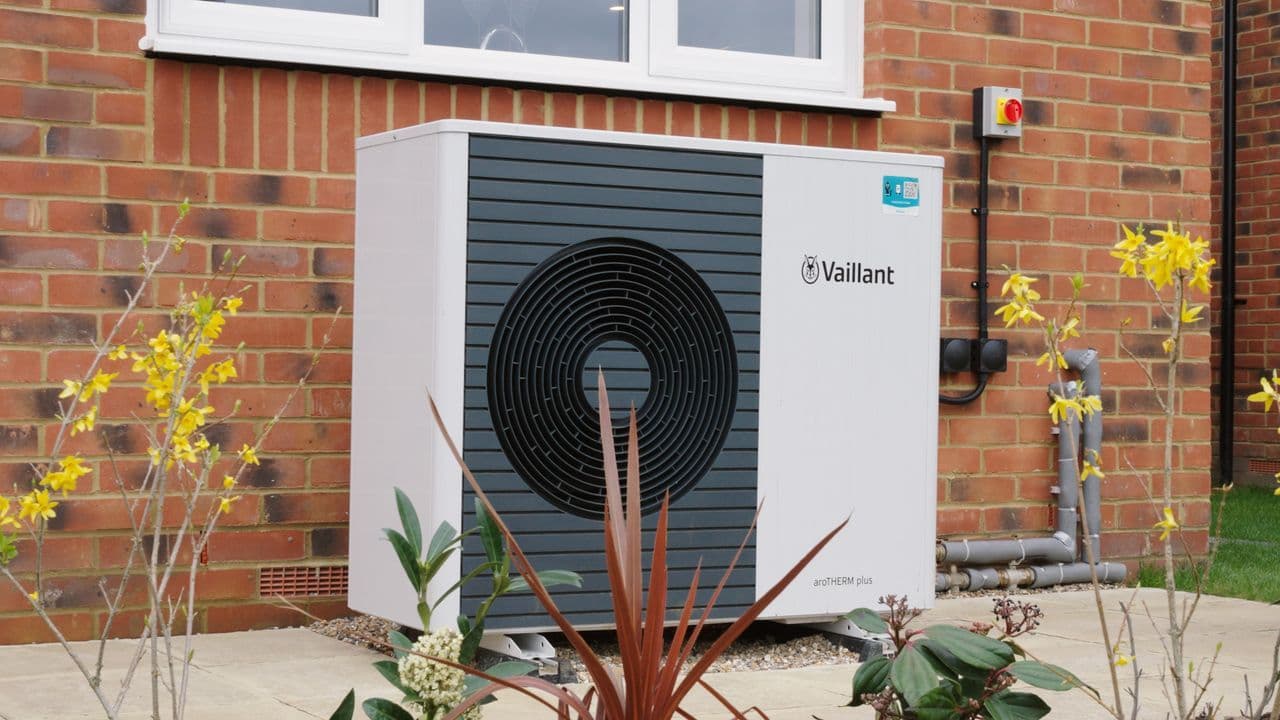
An air source heat pump is a renewable heating system that extracts thermal energy from outdoor air and transfers it indoors to heat your property and provide hot water. Unlike traditional boilers that burn fuel to generate heat, heat pumps move existing heat from one place to another, operating on the same principle as a refrigerator in reverse.
Air source heat pumps work efficiently even in cold weather, extracting usable heat from outdoor air at temperatures as low as -15°C to -25°C depending on the model. This makes them suitable for UK climates year-round, providing consistent, reliable heating throughout winter months.
How Does an Air Source Heat Pump Work?
Air source heat pumps operate through a refrigeration cycle involving four key components:
The Heat Pump Process:
- Evaporator: A fan draws outdoor air across a heat exchanger containing cold refrigerant liquid. Even cold outdoor air contains thermal energy, which the refrigerant absorbs, causing it to evaporate into a gas.
- Compressor: The refrigerant gas is compressed, significantly increasing its temperature and pressure. This compression process requires electricity but delivers 3-4 times more heat energy than the electrical energy consumed.
- Condenser: The hot, high-pressure refrigerant gas passes through a heat exchanger inside your property, transferring its heat to your heating system water. The refrigerant cools and condenses back into a liquid.
- Expansion Valve: The liquid refrigerant passes through an expansion valve, reducing its pressure and temperature before returning to the evaporator to repeat the cycle.
This continuous cycle moves heat from outdoors to indoors, warming your radiators, underfloor heating, and hot water cylinder. The process is highly efficient because it moves heat rather than generating it through combustion.
Benefits of Air Source Heat Pumps
Exceptional Efficiency
Heat pumps deliver 300-400% efficiency (COP 3.0-4.0), meaning for every 1kW of electricity consumed, they generate 3-4kW of heat energy. This makes them significantly more efficient than direct electric heating or even gas boilers, which typically achieve 90-95% efficiency at best.
Dramatically Lower Running Costs
Properties replacing oil, LPG, or electric heating typically save £800-1500 annually on heating costs. Even properties replacing gas boilers can achieve savings, particularly when electricity is sourced from solar PV or time-of-use tariffs offering cheap overnight rates.
Reduce Carbon Emissions
Heat pumps produce zero direct emissions and significantly reduce carbon footprint compared to fossil fuel heating. As the UK electricity grid becomes increasingly renewable, heat pump emissions continue falling. Typical carbon savings are 3-5 tonnes CO2 annually compared to gas heating.
Future-Proof Technology
With the UK phasing out fossil fuel heating by 2035 and the Future Homes Standard requiring low-carbon heating from 2025, heat pumps represent the long-term solution. Installing now protects against future regulation and inevitable fossil fuel price increases.
Government Financial Support
The Boiler Upgrade Scheme provides £7,500 grants for air source heat pump installations, significantly reducing upfront costs. This grant is available for homeowners, landlords, and small businesses, making heat pumps financially accessible for most properties.
Low Maintenance Requirements
Heat pumps require minimal maintenance compared to boilers. No annual servicing is legally required, though we recommend periodic checks every 2-3 years. No flue cleaning, no combustion safety checks, and no carbon monoxide risks. Expected lifespan exceeds 20 years with proper installation.
Coefficient of Performance (COP) Explained
COP measures heat pump efficiency, showing the ratio of heat output to electrical input. A COP of 3.0 means the heat pump produces 3kW of heat for every 1kW of electricity consumed. Modern air source heat pumps achieve:
- COP 4.0+ at outdoor temperatures above 7°C (mild weather)
- COP 3.0-3.5 at outdoor temperatures around 0°C (typical winter)
- COP 2.5-3.0 at outdoor temperatures below -5°C (cold weather)
Even in freezing conditions, heat pumps deliver 2.5-3 times more heat than the electricity consumed, making them far more efficient than any direct electric heating.
Air Source Heat Pumps vs Gas Boilers
Running Costs: Heat pumps typically cost similar to gas boilers for well-insulated properties when accounting for their efficiency. For poorly insulated properties or those replacing oil/LPG, running cost savings are substantial.
Carbon Emissions: Heat pumps produce approximately 50% less CO2 than gas boilers, with emissions continuing to fall as the electricity grid decarbonises.
Heating Performance: Heat pumps provide consistent, gentle heating. Radiators run at lower temperatures (45-55°C vs 60-70°C for boilers) but for longer periods, maintaining steady comfort. Some properties require larger radiators for optimal performance.
Hot Water: Modern heat pumps heat hot water cylinders efficiently, though heating times are longer than combination boilers. Cylinder sizes are typically 200-300 litres, providing ample hot water for family homes.
Frequently Asked Questions
Do air source heat pumps work in cold weather?
Yes, modern air source heat pumps operate efficiently even in freezing conditions. Most models work down to -15°C to -20°C outdoor temperature, well below typical UK winter conditions. While efficiency decreases slightly in very cold weather, heat pumps continue providing reliable heating throughout winter. Cold climate models operate effectively down to -25°C for properties in particularly cold regions.
How much does an air source heat pump cost to install?
Air source heat pump installations typically cost £8,000-£14,000 for residential properties, depending on property size and system complexity. However, the Boiler Upgrade Scheme provides £7,500 government grants, reducing typical costs to £500-£6,500. This grant is deducted directly from your installation cost, not claimed back afterward. We provide detailed quotations including all equipment, installation, and grant deduction.
Will a heat pump work with my existing radiators?
Many properties can use existing radiators with air source heat pumps, particularly well-insulated modern homes. During our heat loss survey, we calculate whether your current radiators provide sufficient heat output at lower flow temperatures (45-55°C). Properties with oversized or newer radiators often require no upgrades. Older properties or those with small radiators may need some radiators replaced with larger models for optimal performance.
Are heat pumps noisy?
Modern air source heat pumps are relatively quiet, operating at 40-50dB at 1 metre distance (similar to a refrigerator or quiet conversation). We position outdoor units away from bedrooms and neighbouring properties where possible. Sound levels decrease significantly with distance - typically 30-35dB at 5 metres. Premium models with inverter technology and sound insulation operate even more quietly. Planning permission requirements include noise level restrictions we ensure compliance with.
How much can I save with an air source heat pump?
Savings depend on your current heating system. Properties replacing oil heating typically save £800-1200 annually. LPG replacement saves £600-1000 annually. Electric heating replacement can save £1000-1500 annually. Properties replacing gas boilers achieve smaller savings, though combining heat pumps with solar PV or time-of-use electricity tariffs significantly improves economics. Our surveys include detailed running cost comparisons for your specific property.
Ready to Switch to Renewable Heating?
Get your free heat loss survey and check eligibility for £7,500 government grant
Or call our team on 01582 363934 • Available Monday-Friday 8am-5pm, Saturday 10am-5pm