
Ground Source Heat Pump Installation
The most efficient renewable heating technology available. Ground source heat pumps extract stable underground temperatures to deliver exceptional year-round performance with minimal environmental impact. Superior efficiency, lower running costs, and ultimate reliability for forward-thinking properties.
Serving businesses and homes across England including London, Birmingham, Manchester, Leeds, Liverpool, Bristol, Sheffield, Newcastle, Nottingham, and Southampton.
Why Choose Universal Gas for Ground Source Heat Pumps?
Expert geological assessment and MCS certified installation for maximum performance
Site Assessment Expertise
Comprehensive ground surveys evaluate soil type, thermal conductivity, water table depth, and available land area. We determine optimal collector type and sizing for your specific geology, ensuring maximum efficiency and return on investment.
Superior Efficiency
Ground source heat pumps achieve COP 4.0-5.0, significantly outperforming air source systems. Stable underground temperatures year-round deliver consistent efficiency regardless of weather, with no performance degradation during cold snaps when heating demand peaks.
Complete Installation Service
We manage every aspect including geological surveys, drilling or trenching permits, ground loop installation, heat pump commissioning, and underfloor heating integration. Single point of contact from initial survey through to performance monitoring.
Commercial Expertise
Large-scale ground source installations for commercial properties, agricultural facilities, housing developments, and public buildings. Borehole fields, energy piles, and shared ground loop systems designed for high-demand applications with exceptional lifecycle economics.
Ground Source Heat Pump Applications
Rural Properties & Estates
Properties with substantial land area benefit enormously from ground source heat pumps. Replace expensive oil or LPG heating with ultra-efficient renewable systems achieving running cost savings of £1,200-2,000 annually. Available land allows economical horizontal ground loops, while isolation from neighbours eliminates noise concerns entirely. Perfect for listed buildings and conservation areas where discreet heating solutions matter.
New Build Developments
Ground source heat pumps installed during construction deliver maximum efficiency and value. Integrate ground loops with foundation work, coordinate with landscaping, and design heating distribution optimally. Developers benefit from superior SAP ratings, future-proof specifications meeting upcoming Building Regulations, and premium property positioning. Shared ground loop systems serve multiple properties economically.
Commercial Properties
Businesses benefit from ground source efficiency economics and corporate sustainability credentials. Offices, hotels, care homes, and retail premises achieve 50-70% heating cost reductions compared to gas boilers. Enhanced Capital Allowances provide significant tax benefits. Exceptional reliability means minimal maintenance and no emergency callouts, while 25+ year lifespan delivers superior lifecycle value versus conventional heating.
Agricultural & Horticultural
Farms and horticultural operations requiring consistent heating benefit from ground source reliability and efficiency. Livestock housing, glasshouses, vertical farms, and agricultural buildings heated economically year-round. Available land allows cost-effective horizontal installations. Agricultural properties often qualify for enhanced grants and renewable heat incentive payments, improving financial returns substantially.
Schools & Public Buildings
Educational institutions and public sector buildings demonstrate environmental leadership while achieving substantial energy savings. Ground source systems provide comfortable learning environments efficiently, with silent operation avoiding classroom disturbance. Schools benefit from educational opportunities around renewable technology. Public sector carbon reduction targets accelerate adoption with dedicated funding streams often available.
Swimming Pools & Leisure
Ground source heat pumps excel at pool heating, delivering water temperatures efficiently year-round. Leisure centres, hotels with pools, and private pools benefit from 60-70% running cost reductions compared to gas or oil heating. Ground loops sized appropriately for high constant loads. Simultaneous domestic heating and pool heating maximises system utilisation and economic returns.
What is a Ground Source Heat Pump?
A ground source heat pump is a renewable heating system that extracts thermal energy stored in the ground or groundwater and transfers it into buildings for space heating and hot water. Unlike air source heat pumps that extract heat from outdoor air, ground source systems utilize stable underground temperatures that remain constant year-round at depths below 1.5 metres, typically 8-12°C throughout the year in the UK.
Ground source heat pumps are recognised as the most efficient heating technology available for buildings, achieving seasonal performance factors of 4.0-5.0, meaning they deliver 4-5 units of heat energy for every 1 unit of electricity consumed. This exceptional efficiency, combined with zero direct emissions, makes ground source heat pumps the ultimate renewable heating solution for properties with suitable land area.
How Do Ground Source Heat Pumps Work?
Ground source heat pumps operate through a closed-loop refrigeration cycle, extracting heat from the ground through buried pipes containing antifreeze solution, concentrating that heat through compression, and transferring it indoors to heat buildings and hot water.
The Ground Source Heat Pump Process:
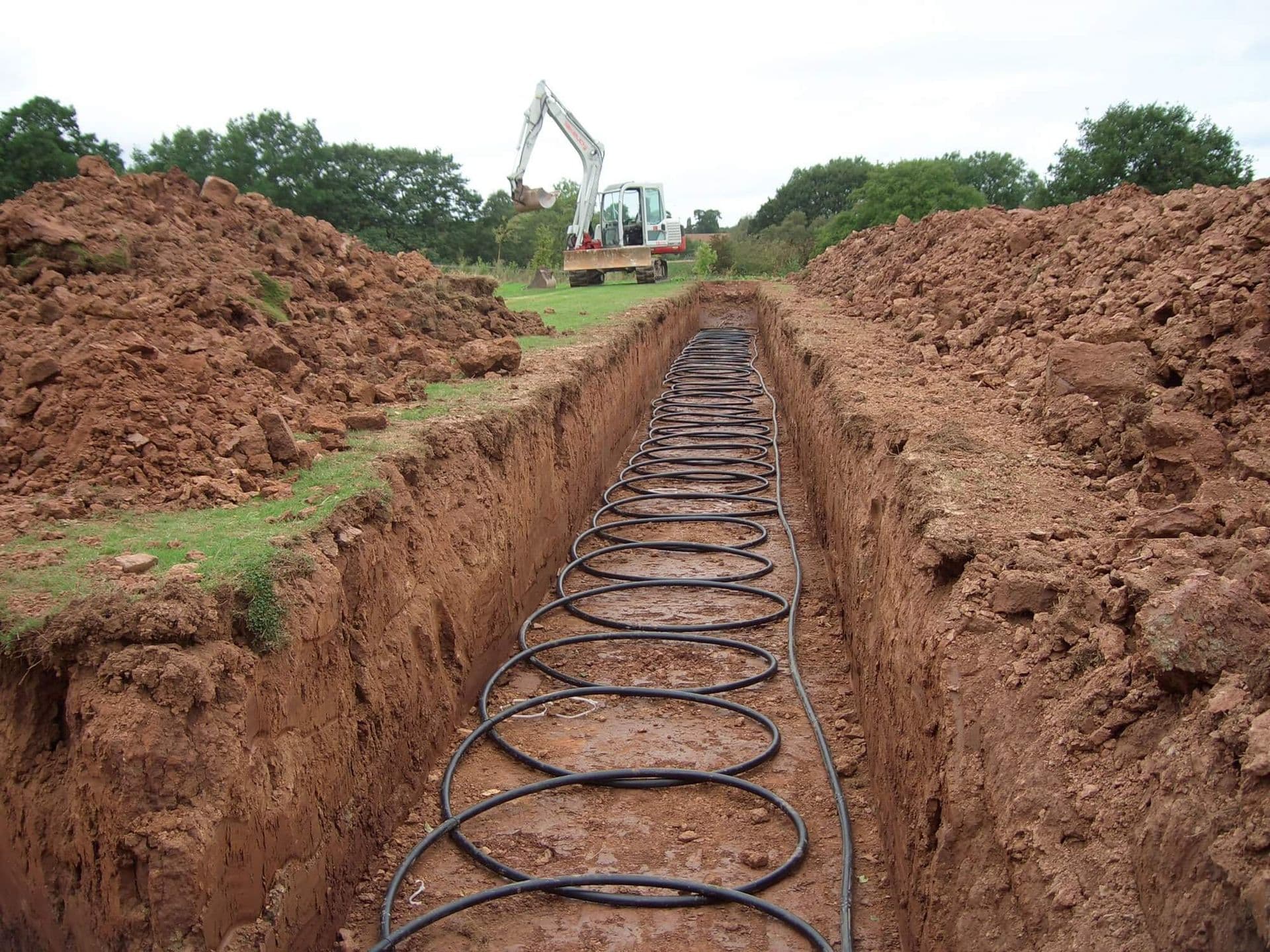
Ground Loop Collector: Pipes buried underground in trenches (horizontal collectors) or boreholes (vertical collectors) contain antifreeze solution that circulates continuously. As the fluid flows through these pipes, it absorbs natural geothermal heat from surrounding soil or rock, warming from perhaps 5°C to 8-10°C.
Evaporator: The warmed antifreeze passes through a heat exchanger where it transfers absorbed heat to refrigerant inside the heat pump. The refrigerant, with a very low boiling point, evaporates into gas even at these relatively low temperatures.
Compressor: The refrigerant gas is compressed, significantly increasing its temperature and pressure. This compression process requires electrical energy but concentrates the low-grade heat extracted from the ground into high-grade heat suitable for building heating, typically reaching 45-55°C.
Condenser: The hot, high-pressure refrigerant passes through a heat exchanger inside the building, transferring its heat to the heating system water circulating to radiators or underfloor heating. The refrigerant cools and condenses back into liquid.
Expansion Valve: The liquid refrigerant passes through an expansion valve, reducing its pressure and temperature dramatically before returning to the evaporator. Simultaneously, the cooled antifreeze solution returns to the ground loop to absorb more heat, completing the continuous cycle.
This process runs continuously when heating is required, extracting consistent heat from stable underground temperatures regardless of outdoor weather conditions, delivering reliable performance throughout the coldest winter days when heating demand peaks.
Benefits of Air Conditioning
For Homes:
Year-Round Comfort: Maintain ideal temperatures throughout every season with systems that both cool and heat your home efficiently.
Improved Sleep Quality: Optimal bedroom temperatures (16-18°C) promote deeper, more restful sleep, particularly important during warm summer nights.
Better Air Quality: Advanced filtration systems remove dust, pollen, and allergens from circulating air, benefiting those with respiratory conditions or allergies.
Energy Efficiency: Modern systems rated A++ or above consume minimal electricity while delivering powerful climate control, with running costs from £0.30 per hour.
For Businesses:
Enhanced Productivity: Studies show employee productivity decreases by up to 20% in poorly ventilated, overheated workspaces. Optimal temperatures (21-23°C) maintain focus and efficiency.
Customer Comfort: Retail environments with comfortable temperatures encourage customers to browse longer, directly impacting sales performance.
Equipment Protection: Server rooms, data centres, and IT infrastructure require consistent cooling to prevent overheating, downtime, and costly equipment failure.
Regulatory Compliance: Workplace temperature regulations require employers to provide reasonable comfort. Air conditioning ensures compliance while demonstrating duty of care.
Energy Efficiency & Running Costs
Modern air conditioning systems deliver exceptional energy efficiency, with the best units rated A+++ for cooling and A++ for heating. Running costs depend on system size, efficiency rating, and usage patterns. Based on current average electricity rates (£0.30 per kWh):
Small Room Unit (2.5kW): £0.20-£0.30 per hour cooling, £0.15-£0.25 per hour heating
Medium Room Unit (3.5kW): £0.30-£0.40 per hour cooling, £0.25-£0.30 per hour heating
Large Room Unit (5.0kW): £0.40-£0.50 per hour cooling, £0.30-£0.40 per hour heating
These costs compare favourably to electric heating (typically £0.60+ per hour for equivalent output) because air conditioning operates as an efficient heat pump rather than direct electric heating.
Frequently Asked Questions
How much land do I need for a ground source heat pump?
Horizontal ground loops require approximately 150-200m² per kW heating capacity, meaning a typical 12kW system needs 1,800-2,400m² (roughly half an acre). Vertical boreholes require only 4-6m² surface area, making them suitable for properties with limited land. Pond/lake systems need water bodies with minimum 3m depth and 30m² surface area per kW. Our site survey determines the most suitable collector type for your available space.
Are ground source heat pumps better than air source?
Ground source heat pumps achieve superior efficiency (COP 4.0-5.0 vs 3.0-4.0), deliver more consistent performance year-round, operate silently with no visible external units, and last significantly longer (25+ years vs 15-20 years). However, installation costs are higher (£18,000-£35,000 vs £8,000-£14,000) and require suitable land area. Ground source offers better long-term value for properties with available land, while air source suits space-constrained properties or tighter budgets.
Discover the Ultimate Renewable Heating Solution
Get your free site assessment and learn if ground source is right for your property
Or call our team on 01582 363934 • Available Monday-Friday 8am-6pm, Saturday 9am-4pm